
Walking Outside vs. Treadmill: Why Your Body Performs Differently Outdoors
You can walk three miles on a treadmill and feel one way.
Then walk three miles on a trail and wonder why your legs, lungs, and energy levels feel completely different.
The distance didn't change.
The environment did.
If you've ever wondered about walking outside vs. treadmill, the answer is that your body isn't simply moving outdoors—it's constantly adapting.
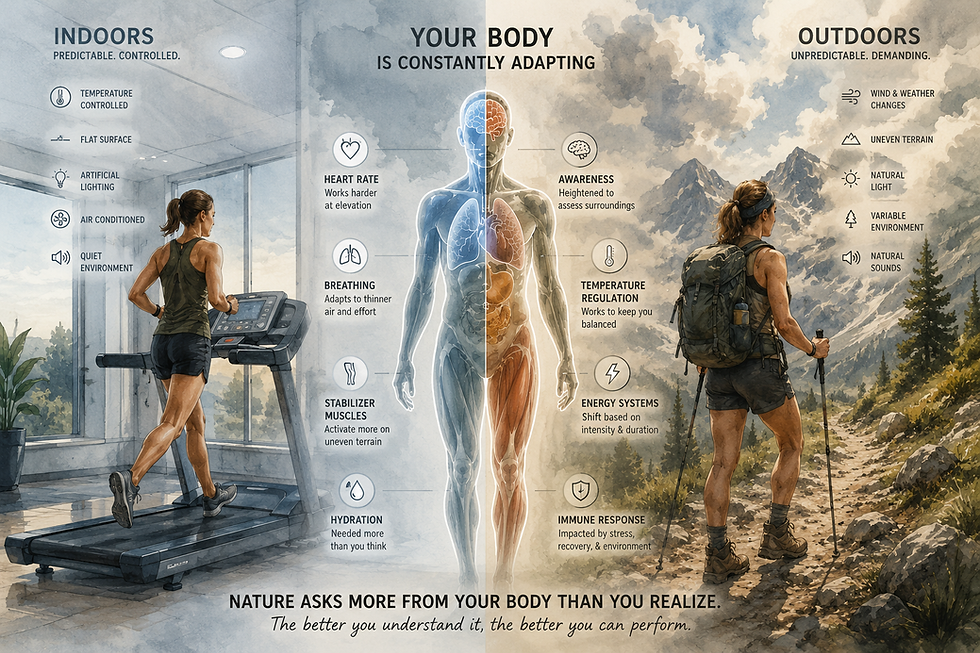
Walking Outside vs. Treadmill: Why the Outdoors Demands More
Uneven Terrain Activates More Muscles
Flat surfaces are predictable.
Nature isn't.
Every root, rock, incline, and patch of loose gravel forces your body to make small adjustments.
Your ankles stabilize.
Your hips engage.
Your core activates.
Your body is solving thousands of tiny problems every hour.
Outdoors, movement becomes full-body movement.
Your Micro Muscles Work Overtime
Most people think movement is powered by large muscles.
But your smaller stabilizing muscles often work the hardest outdoors.
These include muscles around your:
ankles
feet
hips
knees
core
They're constantly helping you balance and adjust.
That's why outdoor movement can create a deeper kind of fatigue.
Environmental Stressors Are Always Present
The outdoors isn't a controlled environment.
Your body is simultaneously adapting to:
heat
humidity
cold
wind
sunlight
altitude
Every one of these variables demands energy.
Even if you don't consciously notice it, your body does.
Temperature Regulation Requires Energy
Your body is always trying to maintain balance.
When temperatures rise, energy is diverted toward cooling.
When temperatures drop, energy is diverted toward staying warm.
This is why the same trail can feel completely different depending on the day.
Your Brain Is Working Too
One of the biggest differences between indoor and outdoor movement is decision-making.
Indoors, the environment rarely changes.
Outdoors, you're constantly processing information.
Your brain is evaluating:
footing
route choices
weather
surroundings
energy reserves
Movement outdoors isn't just physical.
It's cognitive.
The Real Lesson
Nature asks for participation.
That's why outdoor movement often feels harder.
But it's also why it's so beneficial.
The outdoors trains more than your muscles.
It trains adaptability.
And adaptability is a skill that carries into everyday life.
Comments