
How to Choose the Right Hiking Boots
Updated: Aug 4
Walk into almost any outdoor store and you'll see an entire wall covered with hiking boots.
Waterproof. Ultra-light. All-terrain. Backpacking. Trail. Mountaineering.
It's easy to assume the most expensive boot must be the best one.
It isn't.
One of the biggest mistakes new hikers make is shopping for features before they understand their own needs.
The truth is surprisingly simple:
The right hiking boot isn't the one everyone recommends.
It's the one that fits your feet, matches the terrain you actually hike, and allows you to move comfortably mile after mile.
Like every good foundation in nature, the best gear often goes unnoticed because it's doing its job so well.
Your Feet Are Your Foundation
Every hike begins where your feet meet the ground.
If that foundation isn't stable, everything above it has to compensate.

Poor-fitting boots can contribute to:
Blisters
Hot spots
Knee discomfort
Ankle fatigue
Reduced confidence on uneven terrain
The better your foundation, the less energy you spend fighting your gear and the more attention you can give to the trail itself.
This idea reflects the Earth philosophy throughout Live by the Elements: strong foundations support everything built upon them. The same principle applies well beyond hiking, which is why I explore it more deeply in Strong Foundations: What Earth Teaches About Building a Resilient Life. Whether you're building a trail skill or building your character, everything starts with a solid foundation.
Every Foot Is Different
No two hikers have the same feet.
Some people have high arches. Others have low arches or flat feet. Some have wide forefeet, narrow heels, or feet that swell significantly during long hikes.
That's one reason you'll find completely different opinions when reading hiking boot reviews. A boot that feels perfect to one person may cause discomfort for another—not because it's a bad boot, but because our feet are built differently.
Before you spend hundreds of dollars on new footwear, it's worth taking a few minutes to understand your own feet. The better you know what they need, the easier it becomes to choose gear that works with your body instead of against it.
What My Feet Have Taught Me
I've spent most of my life learning what works for my feet—and, more importantly, what doesn't.
Having naturally flat feet (or as I jokingly call them, my "platypus feet") has meant years of trial and error. I've tried different brands, different styles, and even custom orthopedic insoles in search of the right combination of comfort and support.
Ironically, finding shoes that worked with those custom insoles turned out to be almost as challenging as finding comfortable shoes in the first place. If you've ever tried fitting a rigid orthopedic insole into a shoe that wasn't designed for it, you know how quickly the fit can change. Between the extra thickness, reduced toe room, and altered feel, many shoes simply didn't work.
Eventually, I realized something.
The goal wasn't to force my feet to fit a particular shoe.
The goal was to find footwear that worked with the feet I already had.
Today, if you opened my closet, you'd probably notice something unusual. I own far more trail runners, hiking shoes, hiking sandals, and hiking boots than I do everyday sneakers.
That isn't because I'm always on a trail.
It's because, over the years, I've discovered that this style of footwear tends to work best for my feet. Whether I'm heading out for a hike, taking my morning run, or simply walking around town, I consistently find myself reaching for footwear designed for the outdoors.
That lesson became even clearer during one of the biggest adventures of my life—walking across Europe.
What Walking Across Europe Taught Me About Footwear
When I walked across Europe, I carried two primary options for my feet: Merrell Moab Waterproof hiking shoes and Keen closed-toe hiking sandals.
I also brought something else along for the journey—my extremely flat feet.
I jokingly call them my “platypus feet,” but they have been flat for as long as I can remember.
That means footwear has never been as simple as finding my usual size and assuming it will work. Shape, width, flexibility, arch placement, and the way a shoe holds my heel can completely change how comfortable it feels.
Before the trip, I assumed my Merrells would become my primary footwear across Spain. They looked like the more obvious choice for walking long distances over changing terrain.
Instead, I repeatedly reached for my Keen sandals while trekking the Camino de Santiago.
Despite the dirt paths, hills, rocks, heat, and long walking days, the sandals often felt more natural on my feet. They provided room, airflow, and flexibility while still protecting my toes. My feet stayed cooler, and the sandals were easier to manage when conditions were hot or wet.
Surprisingly, I often preferred my Merrells when we encountered longer stretches of pavement. The additional cushioning and structure felt more comfortable against the repetitive impact of walking on hard surfaces.
That experience challenged the assumption that the most rugged-looking footwear is automatically the best choice for every trail.
My sandals were not universally better than my hiking shoes, and my hiking shoes were not universally better than my sandals. Each worked differently depending on the terrain, conditions, and what my feet needed that day.
That is why choosing hiking footwear should begin with an honest understanding of your own feet—not someone else’s recommendation.
A hiker with high arches, narrow heels, wide toes, sensitive pressure points, or naturally flat feet may experience the same shoe very differently. Reviews can help you identify possibilities, but they cannot tell you what will feel right on your body after ten or fifteen miles.
The trail taught me that good footwear is not defined by its category. It is defined by how well it supports the person wearing it.
That lesson extends beyond footwear. One of the greatest teachers on any hike is nature itself. Sometimes the best decisions come from paying attention to what the landscape—and your own body—is trying to tell you. That's a mindset I explore further in Nature as the Teacher: What the Elements Reveal About How We Live.
That experience completely changed the way I shop for footwear. I stopped asking, "What's the best hiking boot?" and started asking, "What do my feet—and the terrain ahead—actually need?"
Fit Always Comes First
Brand loyalty doesn't matter if your feet hurt.
Neither do glowing online reviews.
Everyone's feet are different.
Some hikers have:
High arches
Flat feet
Wide forefeet
Narrow heels
A boot that feels perfect for someone else might become miserable after two miles on your own feet.
A properly fitting boot should feel:
✔ Secure around the heel
✔ Comfortable across the midfoot
✔ Spacious around the toes
✔ Stable without feeling restrictive
If something feels painful while trying it on, don't expect hundreds of miles to magically fix it.
Despite what you've probably heard, boots don't transform into a perfect fit simply because they're worn longer.
Match Your Footwear to the Trail
One reason hikers become uncomfortable isn't because they bought a bad boot.
They bought the wrong boot for the job.

Easy Trails
Ideal footwear:
Trail runners
Lightweight hiking shoes
Best for:
Well-maintained trails
Parks
Dry conditions
Benefits:
Less fatigue
Better airflow
Faster movement
Moderate Terrain
Ideal footwear:
Mid-cut hiking boots
Best for:
Rocks
Roots
Moderate elevation
Benefits:
More support
Better traction
Balanced comfort
If you're hiking over roots, rocks, or uneven ground, your boots and your trekking poles work together. Good footwear provides traction while properly used poles improve balance and reduce strain on your knees. Learn more in How to Use Trekking Poles Correctly while Hiking.
Rugged Terrain
Ideal footwear:
High-cut hiking boots
Best for:
Backpacking
Loose rock
Heavy packs
Technical terrain
Benefits:
Protection
Durability
Increased stability
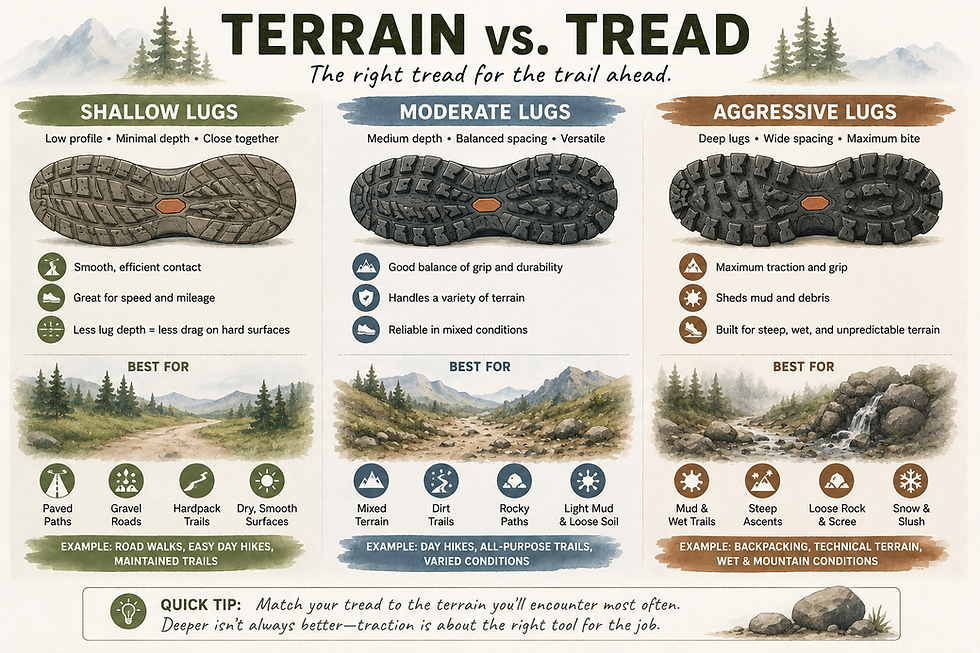
Traction matters just as much as boot height. Different lug patterns are designed for different conditions, and choosing the right tread can improve grip while reducing unnecessary fatigue on the trail.
Just as important as choosing the right boot is understanding the tread beneath it. Different lug patterns are designed for different surfaces, and deeper isn't always better. Matching your tread to the terrain often provides better traction than simply buying a heavier boot.
Don't Forget the Socks
One of the easiest mistakes to avoid happens before you even lace up your boots.
Always try boots on wearing the same socks you plan to hike in.
Sock thickness can noticeably change how a boot fits.
Moisture-wicking hiking socks also reduce friction, helping prevent blisters during longer hikes.
Break In the Hiker—Not Just the Boot
Many hikers talk about breaking in new boots.
What often gets overlooked is that you're also breaking in your understanding of the boot.
Start with short walks.
Notice pressure points.
Experiment with your lacing.
Wear the socks you actually hike in.
The goal isn't to make a painful boot comfortable.
The goal is to confirm that a comfortable boot stays comfortable as the miles add up.
Five Common Boot Buying Mistakes

Heel Lift
Your heel shouldn't slide up and down with every step.
Even a small amount of heel movement can create friction that quickly turns into blisters on a long hike. A properly fitting boot should keep your heel secure while still allowing your foot to move naturally.
Cramped Toes
Too little room in the toe box can become a painful problem, especially on downhill sections where your feet naturally slide forward.
Look for enough space to wiggle your toes without allowing your foot to move excessively inside the boot.
Oversized Boot
Bigger isn't always better.
A boot that's too large allows your foot to slide around inside, increasing the risk of blisters and reducing stability on uneven terrain.
Aim for a secure fit with room for your toes—not extra room everywhere else.
Fashion-first
It's easy to be drawn toward a great-looking boot.
But the trail doesn't care how your boots look.
Comfort, fit, traction, and support will always matter more than style once the miles begin.
Wrong Terrain
One of the most common mistakes isn't buying a bad boot.
It's buying the wrong boot for the trails you actually hike.
Heavy backpacking boots can feel unnecessary on smooth day hikes, while lightweight trail shoes may leave you wanting more protection on rocky, technical terrain.
Choose your footwear for the conditions—not the marketing.
Boots Are Only Part of the Equation
The right boots help, but they aren't a substitute for good movement. Learning to place your feet carefully, read the terrain ahead, and maintain your balance matters just as much as choosing the right footwear.
That's why I recommend pairing good boots with good habits. Developing awareness of the trail around you and learning how to use trekking poles effectively often has just as much impact on your comfort and confidence as buying better gear.
Learning to place your feet carefully, read terrain, and maintain balance matters just as much.
Final Reflection
Good hiking boots don't make you a better hiker.
They simply remove unnecessary distractions.
When your feet are comfortable, your attention shifts from discomfort to discovery.
You notice more.
Move with greater confidence.
Stay out longer.
Enjoy the experience instead of enduring it.
Like the roots of a healthy tree, a strong foundation rarely attracts attention—but everything above it depends on it.
Choose your boots the same way nature builds its strongest forests:
Start with the ground beneath you.
Every hike reminds us that strong foundations create confident journeys. The same lesson appears throughout nature, whether we're talking about the roots of a tree, the habits that shape our lives, or the boots carrying us down the trail. Nature has a way of teaching us that what supports us is often more important than what everyone else notices.
Comments